
When independent schools go co-ed: why culture must lead the design strategy

Author: Truan Stanley
Date: May 07, 2026
The move from single-sex to co-educational is accelerating across the UK independent schools sector, and while leadership teams often focus on admissions modelling, staffing structures, and brand repositioning, one factor remains consistently underestimated: the physical environment.
The starting point should not be furniture or finishes; it has to be culture - because going co-educational isn’t a cosmetic shift, it’s a cultural redefinition, and design either embeds that change or it goes against it.

Moving beyond colour
One of the most persistent misconceptions about co-ed transition design is that it requires little more than visual balancing.
That will be part of the process, but in reality, the shift is far more strategic. Going co-ed means creating environments that are less gender-specific and more flexible - spaces that don’t quietly favour one group over another. This is something all schools should consider, as good design should support a wide range of needs, preferences and ways of learning. Ultimately, every pupil must feel comfortable in the space and able to participate fully, without feeling defined or limited by it.
“The physical environment shapes behaviour,” says Truan. “It signals what is acceptable, who belongs, how to move, where to gather and, just as importantly, where not to.”
When a school transitions to co-education, those signals matter enormously. If the spatial language remains unchanged, the cultural language will too.
Some boys’ schools have a more austere atmosphere, i.e., formal, traditional and occasionally imposing. There will be large common rooms, fixed furniture and grand corridors, and these spaces can subtly reinforce hierarchies and dominance.
Girls’ schools often have very different social patterns, sometimes with alternative rhythms of interaction and use of space.
Both approaches have worked for single-sex schools, but they need to adapt for co-ed schools, because neither is neutral.
Elizabeth College

Buildings as behavioural signalling
Leadership teams understandably focus on admissions and safeguarding policy when planning a move to co-education, but the building itself becomes one of the most powerful agents of change. It is the silent element that reinforces culture.
Students instinctively read space. They understand whether it feels inclusive or intimidating, collaborative or competitive, open or guarded.
“You need to create spaces to accommodate different ways of gathering socially. Some pupils prefer to gather in smaller groups, for example, and there should always be quiet, calm spaces to retreat to. The way you design a space sends out a signal to the students, and schools often underestimate what signals they’re giving,” says Truan.
Getting social spaces right
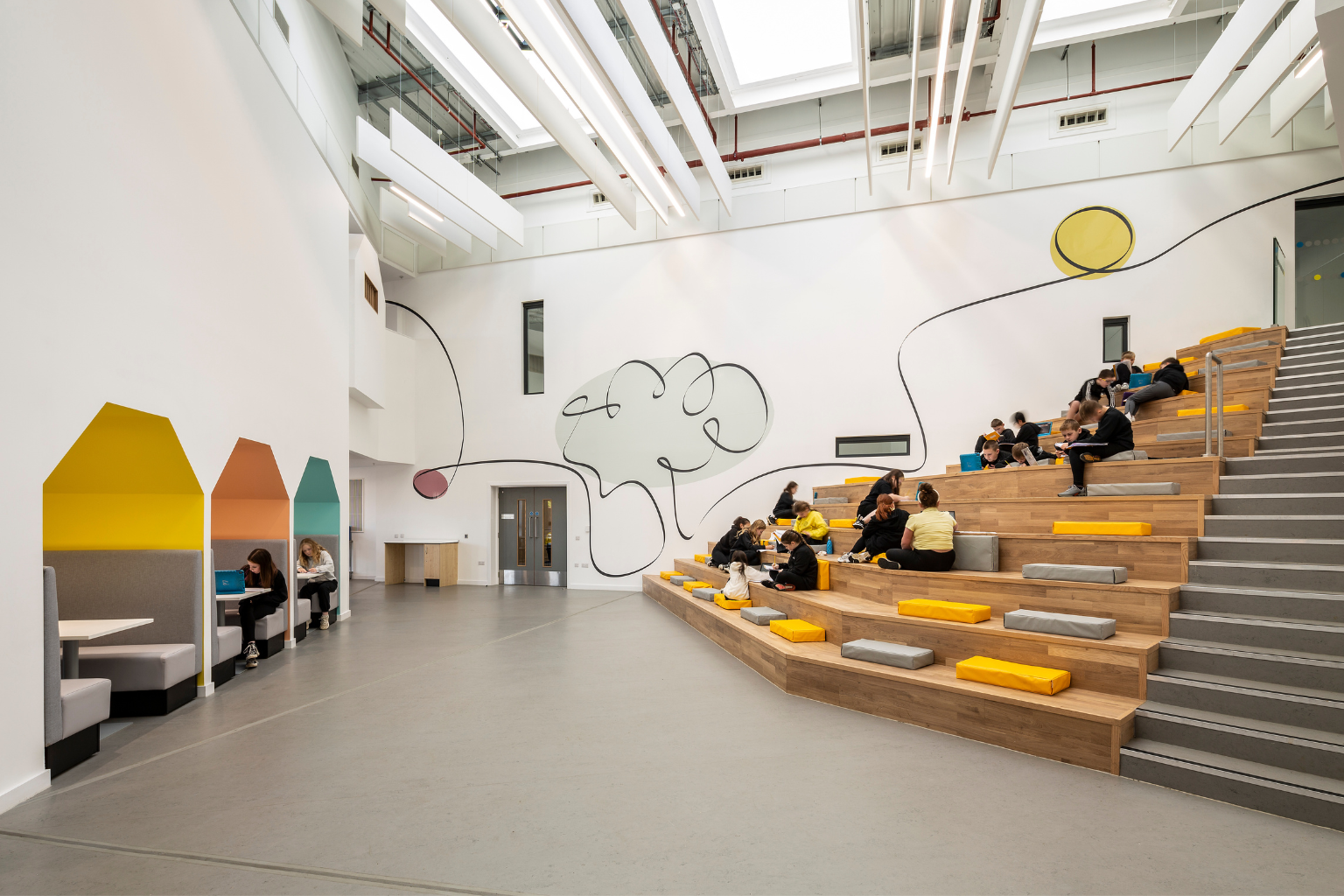
Social spaces are often where the biggest adjustments need to happen. Mixed cohorts bring a broader range of social behaviours and interaction styles. That means designing for a range of needs: different scales of seating, varied breakout areas, and spaces that allow smaller clusters to form without being swallowed by larger groups.
It also means thinking carefully about flow and circulation. Pupils need to feel comfortable as they move through the building - circulation routes need to be spacious and easy to supervise. Flexibility becomes essential. Mobile furniture, adaptable layouts and multi-use zones are not aesthetic upgrades; they are cultural infrastructure.
If a school is embracing change, its environment has to demonstrate that openness.
East Calder Primary School
Toilets and the question of inclusivity
Few areas generate as much discussion during a co-ed transition as toilets and changing facilities.
“Toilets are one of the most sensitive areas,” Truan says. “They can make a huge impact, and you need clear safeguarding through the right combination of visibility and privacy. If you open the toilets up so that the main entrance is visible from the corridor, and then use full-height cubicles inside, it makes the space feel much more secure and welcoming."
“Privacy isn’t just about the washroom entrance - it’s as much about inside the cubicles, and they need to be full height and feel fully private. There’s a lot of discussion on ‘gender neutral’ washrooms, but our advice is not to focus on the label, but more on the function and flexibility. Self-contained and private facilities can be used by anyone."
“The key thing is that everyone has an option. No pupil should feel singled out because of gender. You just need to make sure you’re not channelling pupils into an option. Let them have a free choice.”
Classrooms: enabling pedagogical change
Going co-ed often coincides with a shift in teaching style, and teachers who have only ever taught in a single sex school may need to adapt. Collaboration patterns may evolve, and the classroom has to support that transition.
“Design has got to become an enabler of pedagogy, not just the backdrop,” Truan explains.
Furniture plays a central role here. It needs to be mobile, inclusive and ergonomically considered.
In mixed settings, height, scale and adjustability matter more than ever. Fixed rows convey rigidity and hierarchy, while flexible layouts allow teachers to respond to different dynamics in the room.
If you expect staff and pupils to embrace change, the classroom cannot remain static.
Heritage: modernising without erasing identity
Many independent schools navigating a move to co-education operate within heritage estates. That architectural character is often one of their greatest strengths, and the challenge is not to dilute it.
“Heritage is something you want to complement,” says Truan.
Successful transition lies in understanding what must remain untouched and where light-touch intervention can improve usability. Sometimes that means introducing glass to improve visibility or removing moving outdated additions that obscure original features.
When done well, modernisation can amplify heritage rather than compromise it.
For prospective families, the message should be - tradition is valued here, but the school is not standing still.

Brand, identity and perception
A school that has been known locally for decades as a single sex school cannot expect perception to change overnight.
Brand and identity become critical. Wayfinding, interior finishes, spatial naming and visual cues all contribute to the story the school is telling about its future. The environment must reassure existing families while also signalling confidence to prospective ones.
There is a delicate balance to strike: retaining the essence of the school while making it clear that the next chapter is intentional.
Designing for growth
Co-educational transitions rarely result in perfectly stable pupil numbers. Growth can be phased, uneven and occasionally unpredictable.
That is why adaptability has to be built in from the outset. Folding walls, multi-use spaces, and an infrastructure that allows expansion without permanent disruption are essential.
“You need a clear phasing strategy,” says Truan. “Some schools are in a situation where, from the day a child starts to the day they leave, there’s always been building work happening. That’s not what students want.”
Culture first
When schools consider moving from single-sex to co-educational education, the temptation is to begin with floor plans, but to make the shift a success, leadership teams need to ask the following questions:
What behaviours do you want to encourage?
What values should define the next chapter?
What should it feel like to walk through the doors?
Design decisions should then flow from the answers, because going co-ed is not about adding a new colour palette, it’s about belonging, behaviour and identity. The physical environment doesn’t just respond to cultural change - it shapes it.
Related Blogs and Whitepapers
It’s no coincidence that Tatler’s highest-rated schools are investing in great design
Truan Stanley • November 26, 2025

What can schools learn from modern office design?
Roger Thomson • January 27, 2026

International school franchising: the challenge of scaling British education globally
Daryl Stanley • January 29, 2026