
Designing for neurodivergence benefits every learner

Author: Andrew Ball
Date: March 19, 2026
As awareness of neurodiversity grows across the education sector, schools are increasingly rethinking what effective learning spaces look like. Classrooms designed around a single teaching model are giving way to spaces that recognise the wide range of ways that pupils engage with learning.
This shift is long overdue - in 2024/2025, there was a 15% increase in homeschooling, suggesting that current teaching methods are failing many children.
For designers and school leaders, the question is: how can we make our classrooms more inclusive for children with a range of learning styles?

Andrew Ball, Project Director at Pinnacle, believes the answer lies in designing environments that support neurodivergent learners from the outset, because when spaces are created with that level of flexibility and sensory awareness in mind, they tend to improve the learning experience for all pupils.
“Classrooms that are designed to support neurodivergent pupils usually include better acoustics, better lighting, different seating options and spaces where students can regulate themselves,” he explains. “And those features benefit every learner in the room.”
Rather than treating SEND design as a specialist requirement, Andrew believes it should be viewed as a foundation for effective learning environments.
Many of the elements that help neurodivergent pupils, such as reduced sensory overload, clearer spatial organisation and the ability to change position or environment, also support concentration and well-being for the wider student population.
Moving beyond the traditional classroom layout
Many classrooms still follow a model that has remained largely unchanged for decades: rows of identical desks facing the front of the room.
While this layout works well for certain teaching methods, it can be restrictive for pupils who learn best through movement, collaboration or quieter independent work.
“Traditional classroom layouts are very limited in how they support different needs,” Andrew says. “If all the furniture is fixed and identical, it’s difficult to adapt the space for different learners.”
Flexible classroom environments enable teachers to reconfigure spaces for different activities quickly.
Furniture that can be moved, rearranged or used in multiple ways enables classrooms to shift between group work, independent learning and focused quiet study. Floor-based dividers also enable a level of adaptability that allows teachers to respond more easily to different learning styles within the same class, creating zones that support discussion, collaboration or quiet concentration.
East Calder Primary School

Clear signage and improved flow
Simple layouts with clear signage that make it easy for a child to navigate, along with a design that enhances flow, such as wide corridors to avoid bottlenecks or hidden corners that are hard to supervise, help all children move around the building safely with confidence.
“Any design features that promote autonomy while also promoting safety and well-being are good for all pupils, and flow is an important consideration,” says Andrew.
Choice and autonomy in the learning environment
A key feature of neuro-inclusive design is giving pupils more choice over how they engage with the learning environment.
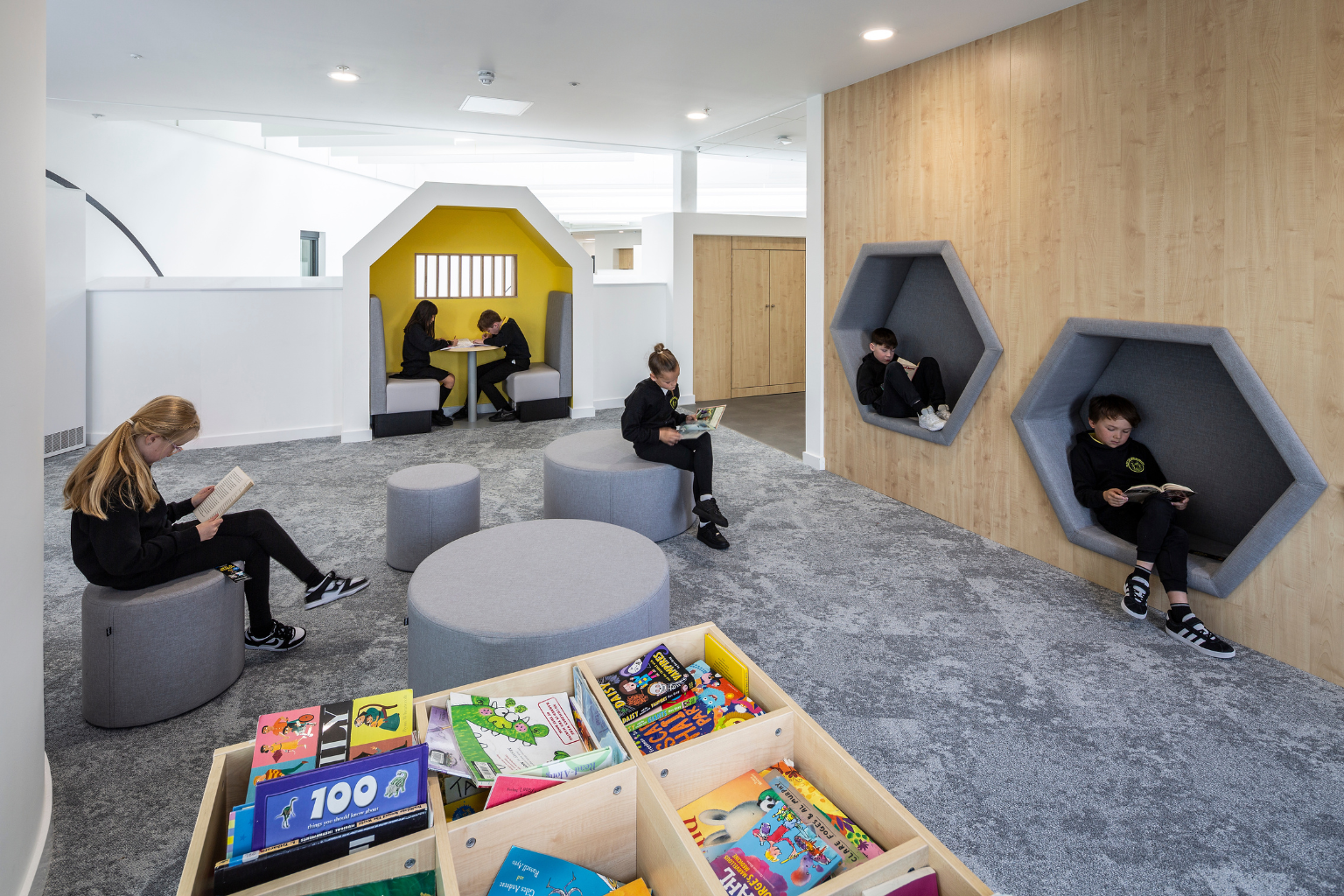
That might mean offering a range of seating such as stools, high tables or soft seating alongside traditional desks. These options allow pupils to select the environment that best helps them to concentrate.
“Choice plays a big role,” Andrew says. “When pupils can choose where they sit or how they work, it helps them feel more comfortable and engaged.”
Research into learning behaviour also suggests that movement can improve concentration, particularly for pupils who struggle to remain still for long periods.
Furniture designed to allow subtle movement while seated can therefore support attention and focus. For many pupils, the ability to shift position or work in a slightly different posture helps maintain engagement during longer lessons.
East Calder Primary School
Spaces for focus and reflection
Another important feature of inclusive learning environments is the availability of smaller breakout spaces that might take the form of quiet corners, small e-learning pods or designated areas where pupils can temporarily work away from the main classroom group.
Such spaces are particularly valuable for pupils who need a moment to regain focus or reduce sensory overload.
But they are equally useful for pupils working independently, completing additional tasks or concentrating on complex work.
“Those kinds of spaces aren’t just for SEND pupils,” Andrew notes. “They’re also useful for high-achieving students who need a quieter place to focus on more advanced work.”
Andrew also explains that it is possible to make space more inclusive without a major rebuild. He says, “In many schools, adapting spaces doesn’t require major reconstruction projects. Small amounts of additional furniture items, such as beanbags, floor cushions or swapping some tables and stools from another room into a standard classroom, can have low-cost, high-impact results.”
Designing environments that evolve with learners
Adaptability is one of the most important aspects of neuro-inclusive design.
Learning styles change as pupils grow, and teaching methods continue to evolve. Spaces that can be reconfigured easily are therefore far more resilient over time.
Andrew believes schools should be less focused on fixed rooms with single purposes and more on flexible spaces that serve multiple functions throughout the day.
“When a space can transform from a classroom into a group area or an individual learning zone, it becomes far more valuable to the school,” he says. “Even the simple act of renaming rooms can expand their usability, for example, turning a meeting or group room into a refocus group room while adding a beanbag and potentially a small amount of wall padding for deep pressure relief, can transform the usability of areas available to a diverse cohort."
“One of the most interesting examples we’ve worked on is East Calder School in Scotland. Their classrooms don’t have walls or doors; they open directly onto the corridor. Instead of physical barriers, pupils are simply told to stay within the carpeted learning area, while the corridor is marked with vinyl flooring or tape. It shows that sometimes you don’t need more walls to manage behaviour - thoughtful design can achieve the same outcome.”
East Calder Primary School

A better environment for everyone
Ultimately, designing for neurodivergence is not about creating specialist environments for a small group of pupils.
It is about recognising that learners engage with space in different ways, and designing classrooms that reflect that reality.
When schools create environments with flexibility, choice and sensory awareness built in, they support a broader range of learning behaviours.
And in doing so, they create spaces that help every pupil thrive.
Related Blogs and Whitepapers

SEND White Paper: Creating Inspiring Learning Spaces for Student Success
March 25, 2024

The importance of learning spaces for ASD children
April 2, 2025

SEND reforms and mainstream schools: why inclusive classroom design matters
Andrew Ball • May 5, 2026